

Best Sierra Trading Post Alternatives 2026
Table of Contents
- Best Sierra Trading Post Alternatives in 2026: What Changed This Year
- How to Compare Discount Outdoor Gear Websites Before You Buy
- Where to Buy Discounted Backpacking Gear: Condition and Inventory Sourcing
- Finding Cheap Camping Gear Online Without Sacrificing Durability
- Discount Hiking Gear: Matching the Retailer to Your Activity
- Returns, Warranties, and Customer Service: The Fine Print That Matters
- Price Tracking and Deal Verification: How to Confirm a Markdown Is Real
- Conclusion: Choosing the Right Sierra Trading Post Alternative for You
- Frequently Asked Questions
Last Updated: October 16, 2026
Best Sierra Trading Post Alternatives in 2026: What Changed This Year
The discount outdoor gear landscape shifted noticeably in 2026. Sierra Trading Post, once the default answer for brand-name hiking gear at steep markdowns, now operates as part of a larger retail network, and shoppers report that its closeout inventory turns over faster and its discount depth varies more than it used to.
This guide from Prestige Outdoor Homes breaks down how to compare discount outdoor gear websites honestly: what total cost actually includes, how to read outlet labels, and which retailer type fits your activity. Below, we'll show you exactly how to evaluate a markdown before you trust it.
How to Compare Discount Outdoor Gear Websites Before You Buy
Comparing discount outdoor gear websites starts with one question: what does the item cost after shipping, returns, and your time? A low sticker price means nothing if shipping adds a fee or the return window is too short to matter.
The Five Criteria That Actually Change Your Total Cost
Use these five criteria to score any gear retailer before you commit:
| Criterion | What to Check | Why It Matters |
|---|---|---|
| Discount depth | Markdown vs. original MSRP | Shows if the "sale" is real |
| Shipping threshold | Free shipping minimum | Adds to your true total |
| Return window | Days allowed, condition rules | Protects a bad fit |
| Inventory sourcing | Overstock, past-season, or seconds | Explains the low price |
| Warranty coverage | Manufacturer vs. retailer only | Determines long-term value |
A common mistake is judging a retailer on one order. The better test is whether the same site consistently stocks the categories you actually buy. If you mostly need camping gear, a site that excels at running shoes won't help you.
Where to Buy Discounted Backpacking Gear: Condition and Inventory Sourcing
Where to buy discounted backpacking gear depends on what condition you'll accept. Most discount retailers source inventory from three places: overstock, past-season gear, and closeout items. Each carries a different risk level.
- Overstock: Extra units a brand couldn't sell. Usually new, full warranty.
- Past-season gear: Last year's color or model. Functionally identical, often the best value.
- Closeout: Discontinued lines. Cheapest, but replacement parts get harder to find.
The Federal Trade Commission's guidance on online shopping is worth reading before any large gear purchase, since it explains your rights on returns and misrepresented condition. For backpacking specifically, check that load-bearing items like packs and tents still carry a manufacturer warranty.
Finding Cheap Camping Gear Online Without Sacrificing Durability
Cheap camping gear online is only a bargain if it survives more than one trip. Durability comes down to materials and stitching, not price alone. Look for reinforced stress points on tents, taped seams on rain gear, and metal rather than plastic hardware on packs.
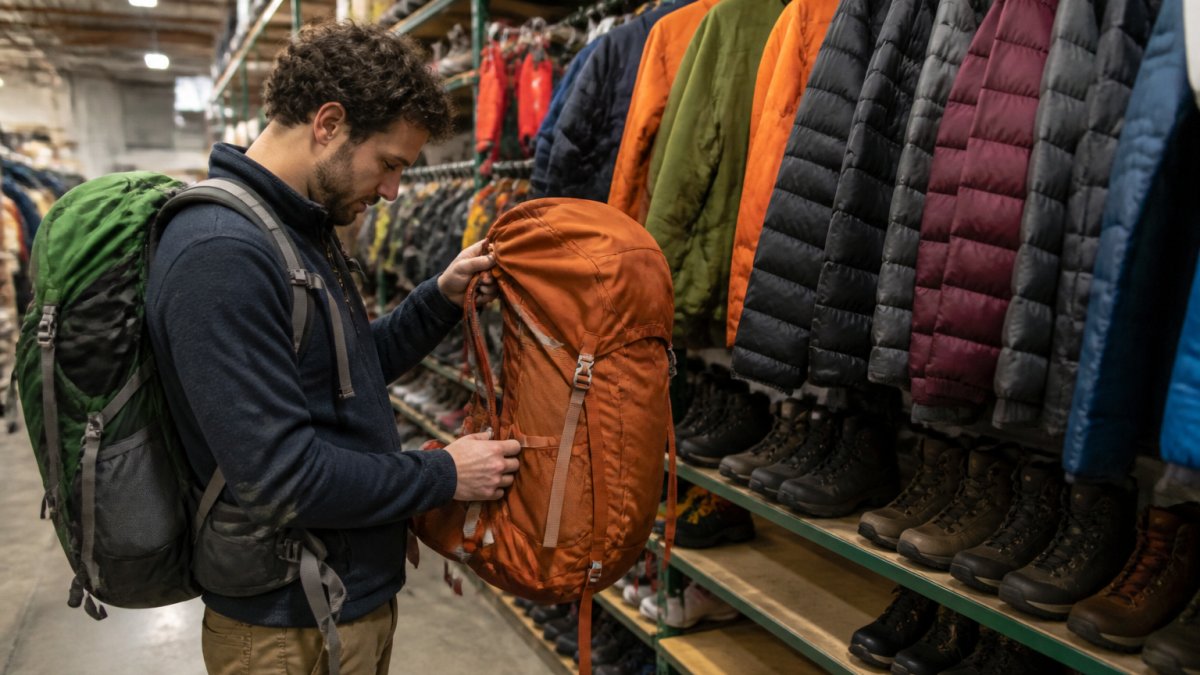
Outlet, Clearance, and Closeout Sections: How to Read the Labels
Outlet, clearance, and closeout labels are not interchangeable. Outlet items are often made for the outlet channel with slightly different specs. Clearance means the retailer is exiting that stock. Closeout usually means the brand discontinued it. Reading the label tells you whether you're getting the same product at a lower price or a different product entirely.
Discount Hiking Gear: Matching the Retailer to Your Activity
Discount hiking gear is not one category, and the "best" alternative depends on what you're buying. A store that wins on day-hike apparel can be the wrong pick for a multi-day backpacking kit. Below is how the major alternative types break down by activity, followed by a total-cost comparison so you can judge the final price rather than the advertised markdown.
Best Alternative by Activity and Shopper
- Backpacking (packs, shelters, sleep systems): Prioritize retailers that carry current-model, full-warranty gear and publish weight specs. Mass-market closeout sites often stock discontinued pack lines where replacement hip belts and tent poles are already hard to source. Specialty discounters and brand-owned outlet stores are the stronger fit here.
- Day hiking (apparel, footwear, small accessories): This is where general closeout and overstock retailers shine. Turnover is fast, sizes are hit-or-miss, and the discount depth is usually deepest on last-season colorways.
- Camping (stoves, coolers, family tents): Big-box outdoor retailers and warehouse clubs compete on volume here, and their return windows tend to be the most forgiving on bulky items.
Total Purchase Value: Comparing the Real Cost, Not the Markdown
Advertised discount depth is the least reliable number on a product page. What changes your final cost is shipping thresholds, membership fees, return shipping, and restocking charges. The table below compares the typical structure of each retailer type, verify current terms on the site before you buy, since these change often.
| Retailer type | Typical discount depth | Shipping model | Return window | Membership fee |
|---|---|---|---|---|
| Closeout / overstock discounter | Deepest on past-season and discontinued stock | Free-shipping minimum, often in the $50-$100 range | Short, frequently 30 days or less | None |
| Brand-owned outlet | Moderate, mostly last-season colorways | Free over a threshold; some charge flat rate | Standard retail window, often 30-60 days | None |
| Warehouse club | Moderate, volume pricing | Free for members | Generous, sometimes no time limit on general merchandise | Annual membership required |
| General merchandise marketplace | Shallow to moderate | Varies by third-party seller | Varies by seller; often the weakest link | None |
| Specialty outdoor retailer (sale section) | Shallow to moderate, best on full-warranty goods | Free over a threshold | Longest, often 60+ days | Optional loyalty program |
Run the math on a single representative item before you commit.
Inventory Sourcing: Why the Same Brand Costs Different Amounts
Most discount retailers pull from four inventory pools, and the pool determines both your price and your risk:
- Overstock: Extra units a brand couldn't sell through normal channels. Usually new, current-generation, and covered by the full manufacturer warranty.
- Past-season gear: Last year's model or colorway. Functionally identical to current stock in most cases; often the single best value in outdoor gear.
- Closeout: Discontinued lines the brand has exited. Cheapest, but replacement parts and accessories get harder to find every season.
Before buying any load-bearing item, a pack, a tent, a sleeping bag, confirm two things on the product page: whether the manufacturer warranty still applies to that inventory pool, and whether the retailer publishes a condition grade.
Returns, Warranties, and Customer Service: The Fine Print That Matters
Returns and warranties decide whether a discount is worth the risk, and this is the section most discount-gear guides skip. Here's how the mechanics actually work, so you can compare policies instead of guessing.
The Four Numbers That Determine Your Real Return Cost
- Return window length. Counted from delivery date, not order date. A 30-day window sounds generous until a backordered item ships two weeks late.
- Who pays return shipping. "Free returns" usually means a prepaid label; "easy returns" often means you pay postage. On a bulky item like a tent or cooler, return shipping can exceed the discount you captured.
- Restocking fees. Common on large items, electronics, and some closeout stock. A 15% restocking fee on a $200 item is $30, enough to erase a shallow markdown.
- Final-sale flags. Clearance and closeout items are frequently marked final sale, which means no return at all regardless of the posted window.
Manufacturer Warranty vs. Retailer Guarantee
These are not the same thing, and the distinction matters most on discounted stock:
- Manufacturer warranty covers defects in materials and workmanship for a defined period, typically one year or longer on outdoor hardgoods. It generally follows the product, not the retailer, so it usually survives a closeout purchase, if the item is genuine first-quality stock.
- Retailer guarantee is a store-level return or exchange policy. It expires on the retailer's schedule and does not cover defects that show up after the window closes.
- Seconds, refurbished, and used items are where coverage gets murky. Many brands exclude these from warranty coverage entirely, and some retailers pass that exclusion through without flagging it prominently.
Before ordering a load-bearing item, check the brand's warranty page directly rather than relying on the retailer's summary. If the product page doesn't state whether the manufacturer warranty applies, ask customer service in writing and keep the response.
How to Resolve a Disputed Order
If a return goes sideways, the item arrives damaged, the condition doesn't match the listing, or the retailer refuses a return that the posted policy allows, work through these steps in order:
- Document everything. Photograph the item and packaging on arrival, and save the product listing, order confirmation, and any condition grade shown at checkout.
- Request the resolution in writing. Use the retailer's contact form or email rather than phone so you have a record. State the policy you're relying on and the outcome you want.
- Escalate to your payment method. Credit card issuers generally allow you to dispute a charge for goods not received as described, and the Consumer Financial Protection Bureau's resources on purchase protections explains how those disputes are typically handled. This is often the fastest path when a retailer stops responding.
- File a complaint if the pattern is widespread. The Federal Trade Commission's guidance on online shopping covers your rights on returns and misrepresented condition, and the FTC accepts complaints about deceptive sales practices.
Price Tracking and Deal Verification: How to Confirm a Markdown Is Real
Confirming a markdown is real takes about two minutes. Copy the model name, paste it into a price-history tool, and check the 90-day average. If today's price sits below that average, the deal is genuine.
Qualified signals that a markdown is real:
- The price is lower than the 90-day average
- The item is marked as limited-time or limited-stock
- The retailer lists the original MSRP for comparison
Signals it isn't:
- The "sale" price matches the everyday price elsewhere
- No MSRP reference is shown
- The discount resets every week
Conclusion: Choosing the Right Sierra Trading Post Alternative for You
The right alternative depends on your activity, not on which site shouts the loudest about discounts. Compare total cost, check return windows, and verify markdowns before you buy. Prestige Outdoor Homes carries camping gear, fitness equipment, and home accessories in one place, with free shipping on all orders, so you can stock a full trip without juggling multiple carts. Browse the catalog and build your next gear list in one stop.
Frequently Asked Questions
Are there other stores like Sierra Trading Post for discounted outdoor gear?
Yes. Several retailers carry past-season and overstock inventory, including outlet sections on major outdoor brand sites, general discount chains, and online-only shops that buy closeout stock. The key differences are inventory sourcing (overstock versus returns versus closeout), return windows, and whether shipping is included. Compare the total delivered cost, not just the sticker price, because a lower item price with paid shipping and a restocking fee can cost more than a slightly higher price with free shipping.
What should I compare when choosing a discount outdoor gear website?
Focus on five things: product condition (new, past-season, or factory seconds), inventory sourcing, shipping threshold and free shipping rules, return policy including who pays return postage, and warranty coverage from the manufacturer. Also check whether sizes and colors are actually in stock when you order, since discount retailers sell limited quantities. A retailer with a generous return window and free shipping often delivers better total value than one with deeper markdowns and restrictive policies.
Where can I buy cheap camping gear online without risking quality?
Look for retailers that clearly state the condition and sourcing of each item, name the brand, and publish a return policy you can read before checkout. Past-season gear from established brands is usually the same construction as current models, just older colors or packaging. Avoid listings with no brand name, no condition notes, and no stated return window. Reading the condition label and the warranty terms takes two minutes and prevents most disappointing purchases.
How do I verify a discount on hiking or backpacking gear is real?
Check the manufacturer's current listed price for the same model, then compare the retailer's price against it, not against a crossed-out number on the product page. Some retailers inflate the original price to make the markdown look bigger. Also factor in shipping and any membership fees. A 30 percent markdown with $12 shipping can be a smaller saving than a 20 percent markdown with free shipping. Price-tracking tools and browser extensions can show a product's price history over recent months.