

Which Tactical Flashlight Is Best for Camping in 2026?
Last Updated: October 30, 2026
Quick Summary
The Wurkkos TD01C is the best overall tactical flashlight for camping in 2026, balancing 1800 lumens of output in a compact body with USB-C charging and IPX8 water resistance. For open ground, the Sofirn SK40 offers a longer throw, while the Wurkkos TD07 suits pocket or backpacking backup use.
- The TD01C lists 1800 lumens and a range of up to 1000 meters from one 21700 battery.
- The SK40 offers a long throw of up to 580 meters, suited to open terrain.
- The SK31 has three switches and a removable battery, with up to 500 hours on low.
- Turbo output steps down quickly, so plan camp use around medium and low modes.
- The TD07 is the most compact option, rated IP68 with a ring handle for attaching to gear.
Table of Contents
- How We Picked These Five Tactical Flashlights
- 1. Wurkkos TD01C: Best Overall Balance of Output and Size
- 2. Sofirn SK40: Long-Range Throw for Open Terrain
- 3. Sofirn SC33: High Output With Auto Lockout
- 4. Sofirn SK31: Triple-Switch Control and Long Runtime
- 5. Wurkkos TD07: Compact Build for Everyday Carry
- Runtime, Batteries and Charging on the Trail
- Frequently Asked Questions
Choosing the right light makes a camping trip safer and more comfortable, and a tactical flashlight is often the best fit for campers who want durability and a focused beam.
That said, a tactical flashlight is not automatically right for every camper. A bright, long-throw beam can be harsh inside a tent, and some models drain batteries quickly on high output.
Watch out: Many tactical lights run their brightest modes for only a short time before dropping output to protect the driver.
How We Picked These Five Tactical Flashlights
Most tactical-flashlight roundups rank lights on headline lumens and throw distance, then hand out a "best overall" badge. That breaks down at a campsite, where the real jobs are setting up a tent at dusk, walking a root-tangled trail to the restroom, reading a map without wrecking your night vision, and signaling for help.
The criteria, in order:
- Usable runtime at the modes you will actually run. A 5,200-lumen turbo mode is a party trick if it steps down after a minute. We looked at what each light does on medium and low, where a camping light spends most of its night; where a listing publishes runtime at each level, it is a useful planning reference.
- Battery and charging logistics. Four of the five lights here run on a 21700 lithium-ion cell, one on an 18350. On a multi-day trip, the questions are: Can the cell be swapped for a spare? Does the light charge over USB-C from a power bank or car outlet? Is the cell a common, replaceable size, or proprietary? A light with a sealed, non-replaceable battery is a paperweight once it dies at 2 a.m.
- Beam shape and low modes for camp comfort. A tight, long-throw beam is excellent for scanning open ground and miserable inside a tent, where it blows out your night vision and glares off nylon walls. We favored lights with a genuine low or moonlight mode and, where available, a red or low-output option for map reading and wildlife observation.
- Hands-free and pack-friendly design. Camp chores need two hands. A light that clips to a belt, hangs from a ring, or stands on its tail for ceiling-bounce tent lighting earns its place; one that only works in a fist does not. Weight without the battery varies between models, and a compact light and a heavier thrower serve different trips.
- Durability and weather resistance you can interpret. An IPX8 or IP68 rating means the light survives submersion under stated test conditions, not that it is indestructible. Drop resistance and switch design matter because a tail switch that fires accidentally inside a pack is a real campsite annoyance.
- Switch logic and safety. Tactical switches are built for fast, one-handed activation, which is great for signaling and less great when a light turns on in your bag. Lights with lockout or a deliberate multi-step activation are worth considering, and strobe is best treated as a signaling tool.
A common pattern among high-output tactical lights is aggressive thermal step-down: the driver cuts output to protect itself, so the brightest mode is the shortest-lived one.
Specifications come from each product listing and are a starting point for comparison. Lumen and beam-distance figures are measured under conditions that differ from a real campsite, so use them to compare models against each other rather than as promises about your trip.
1. Wurkkos TD01C: Best Overall Balance of Output and Size
The Wurkkos TD01C is a strong choice for most campers.

Pros: Strong output in a compact body, USB-C charging, a dual-switch layout that is easy to learn, and IPX8 water resistance for wet camping.
Cons: The listing notes a visible straight line on the optic from the molding process, which does not affect water resistance but may bother some buyers.
Best for: Campers who want one light for camp chores, trail use, and emergencies.
Price: $84.99
2. Sofirn SK40: Long-Range Throw for Open Terrain
The Sofirn SK40 is suited to longer throws. Its SFT70 LED is listed at up to 3200 lumens with an illumination range of up to 580 meters.

Pros: Long throw suited to open ground and large campsites, dual switch design, and IP68 water resistance in the listing.
Cons: Its high-output modes will shorten runtime.
Best for: Campers who spend time on open ground, in desert or prairie settings, or who need to scan a wide area after dark.
Price: $65.99
3. Sofirn SC33: High Output With Auto Lockout
The Sofirn SC33 offers high output in a tail-switch design. It uses an XHP70.3 HI LED listed at up to 5200 lumens, runs on a single 21700 battery, and charges over USB Type-C.

Pros: Very high listed output, auto lockout to prevent the light switching on inside your pack, and IP68 water resistance.
Cons: High output drains the battery quickly, so you will want to use lower modes for most camp tasks.
Best for: Campers who want maximum brightness for search or signaling and are comfortable managing battery use.
Price: $60.99
Wurkkos TD01C 21700 Rechargeable Tactical Flashlight LED USB-C 1800Lm Torch →
4. Sofirn SK31: Triple-Switch Control and Long Runtime
The Sofirn SK31 stands out for control. It has three switches (a tail mechanical switch, a tail toggle, and a neck electronic switch), which let you move between tactical and outdoor modes and access a one-touch strobe quickly.
Pros: Three-switch control, a removable battery that can be swapped for a spare, a strike bezel, and a long listed runtime on low.
Cons: At $93.99 it is the most expensive light in this group.
Best for: Campers who want precise mode control and long low-level runtime for camp tasks.
Price: $93.99
5. Wurkkos TD07: Compact Build for Everyday Carry
The Wurkkos TD07 is the most compact tactical light here. It is listed at 1300 lumens with a 479-meter beam, runs on an 18350 battery, and is rated IP68.
Pros: IP68 water resistance and a ring handle for attaching to gear.
Cons: Its lower listed output means it is less suited to long-range search than the larger models.
Best for: Campers who want a backup light for the pocket or belt, or a lightweight option for backpacking.
Price: $49.99
Runtime, Batteries and Charging on the Trail
This is the section most flashlight roundups skip, and it decides whether your light works on night three of a trip. Headline lumens sell lights; runtime at the modes you actually use keeps them running.
Read runtime by mode, not by headline
A tactical light's spec sheet usually leads with maximum output and beam distance, then buries runtime in a table. The pattern to understand is step-down: on turbo and high, the driver and LED generate heat fast, and the light cuts output to protect itself, often within a minute or two.
A practical way to plan: estimate your nightly light budget in hours, then check that your chosen light's medium-mode runtime covers it with margin.
Battery chemistry and what it means for a trip
Four lights in this guide run on a 21700 lithium-ion cell; the TD07 runs on a smaller 18350. The 21700 is a common, high-capacity size with good spare availability, which is why it dominates this list. The 18350 is smaller and lighter, suiting a pocket backup, but it carries less energy, so expect shorter runtime at the same output.
Lithium-ion cells hold charge well and do not suffer the memory effect of older chemistries, but they dislike extreme cold. Never carry a loose lithium-ion cell where it can contact metal (keys, a knife, a zipper); a shorted cell can vent or catch fire (CPSC Issues Consumer Safety Warning).
Charging logistics for multi-day trips
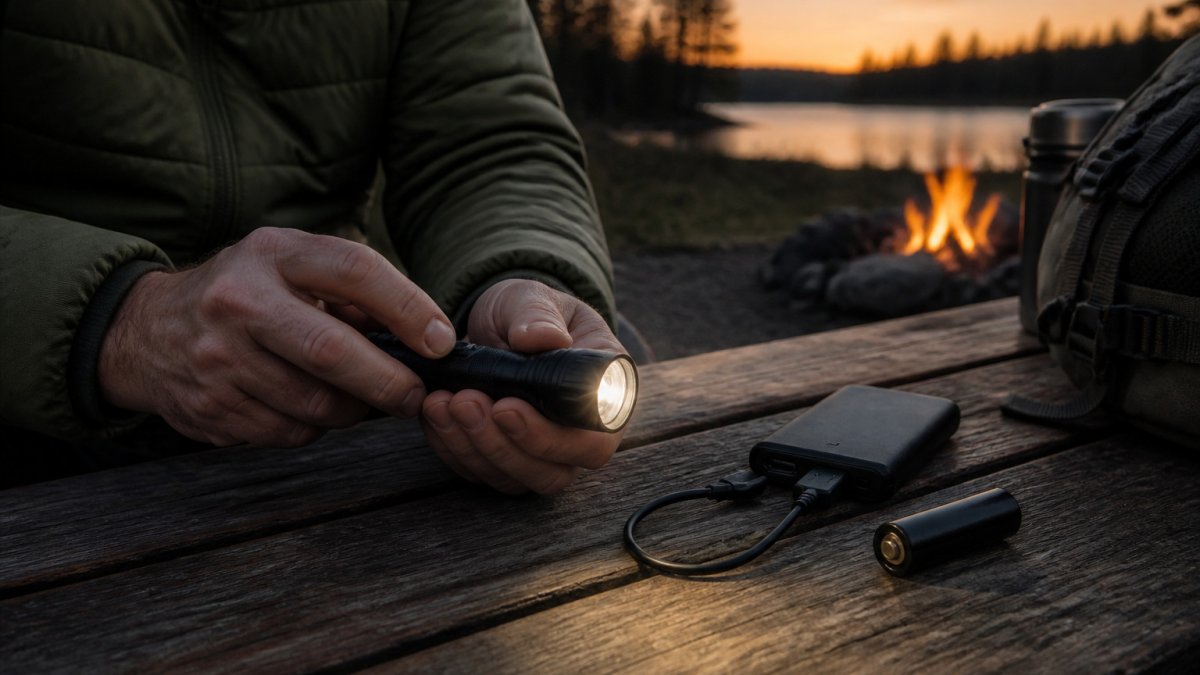
USB-C charging on the light is convenient for car camping and base camps with a power bank or vehicle outlet. For backcountry trips, every charge you carry is weight, and a light that charges only in the light means you cannot use it while it tops up. That is the argument for a swappable cell: with a spare 21700 and a small charger, you can run one cell while the other charges.
A few practical rules for lights of this type:
- Charge everything the night before you leave, and top off spares, not just the installed cell.
- Carry the right cable. USB-C is standard here, but bring a cable that matches your power bank or charger, and a short one saves pack space.
- Match charging to your power source. A vehicle outlet, a power bank, and a solar panel deliver different rates; a light that charges slowly from a small panel may not finish before morning.
- Check the battery indicator before dark. Most of these lights have one; use it while you still have daylight and options.
Beam color, night vision, and campsite comfort
Bright white light is not always the right light. Your eyes adapt to darkness over roughly 20 to 30 minutes, and a blast of high-output white light resets that adaptation, which is why a bright beam inside a tent feels blinding.
Save the high and turbo modes for what they are good at: scanning open ground, signaling for help, and lighting up a trail junction from a distance. Used that way, a tactical light's output is an asset rather than a battery drain.
Frequently Asked Questions
What is the best tactical flashlight for camping?
The Wurkkos TD01C at $84.99 offers a strong balance of output, size and waterproofing. It delivers up to 1800 lumens, runs on a single 21700 rechargeable battery charged over USB-C, and carries an IPX8 rating. If you camp in open terrain and need reach, the Sofirn SK40 at $65.99 throws its beam up to 580 meters. Choose based on whether your trips favor throw distance or all-around use.
How many lumens do you need for a camping flashlight?
Most camp tasks, such as setting up a tent, cooking and moving around the site, are well served by a few hundred lumens on a medium setting. For trail navigation or spotting wildlife at a distance, look for 1000 lumens or more on a high setting. Lumen ratings are measured at the peak mode, so the lower modes will run longer and are usually what you need at camp.
Are tactical flashlights good for camping?
Yes. Many tactical flashlights are built from aluminum alloy, and the Sofirn SC33 at $60.99 is listed with an IP68 rating. Their tail switches allow quick access in an emergency, and strobe modes can signal for help. The tradeoff is that some models are heavier or more focused than a standard lantern, so pair one with a diffused light for camp tasks.
How long should a flashlight last on a camping trip?
A good camping flashlight should last at least one full trip on the mode you actually use. Runtime depends heavily on brightness. The Sofirn SK31 at $93.99 is rated for up to 500 hours on its lowest setting, while high modes drain the cell far faster. Carry a spare charged battery or a power bank for trips longer than three or four days, and check the runtime figures for each mode before you buy.
