

Setting Up a Home Gym in a Small Apartment: 2026 Guide
Table of Contents
- Small-Space Workout Layout: Measuring Before You Buy
- Space-Saving Home Gym Equipment That Actually Fits
- Budget Home Gym Setup: Where to Spend and Where to Save
- Quiet Apartment Workout: Noise Reduction and Vibration Dampening
- Vertical Storage Hacks and Rental-Friendly Modifications
- Equipment Maintenance in Small Environments
- Conclusion: Your Apartment Home Gym Starts With a Plan
- Frequently Asked Questions
Last Updated: October 7, 2026
Small-Space Workout Layout: Measuring Before You Buy
Setting up a home gym apartment starts with a tape measure, not a shopping cart. Most people buy equipment first and figure out where it goes later. That order leads to returns, clutter, and a workout zone you avoid.
So before you spend a dollar, measure three things: usable floor space, ceiling height, and doorway clearance. Below, we break down exactly how to do each one.
How to Calculate Usable Square Footage for a Home Gym
Usable square footage is the open floor area left after you subtract furniture, doors, and walkways. A 10-by-12-foot room sounds generous until a couch and coffee table eat half of it.
Here is the simple math:
- Measure the room's length and width in feet.
- Multiply them to get total square footage.
- Subtract the footprint of permanent furniture.
- Subtract 3 feet of clearance in front of any door.
- The number left is your usable space.
Most apartment workout zones need at least 6 by 6 feet for floor work and dumbbell training. A squat rack or barbell setup needs closer to 8 by 8 feet.
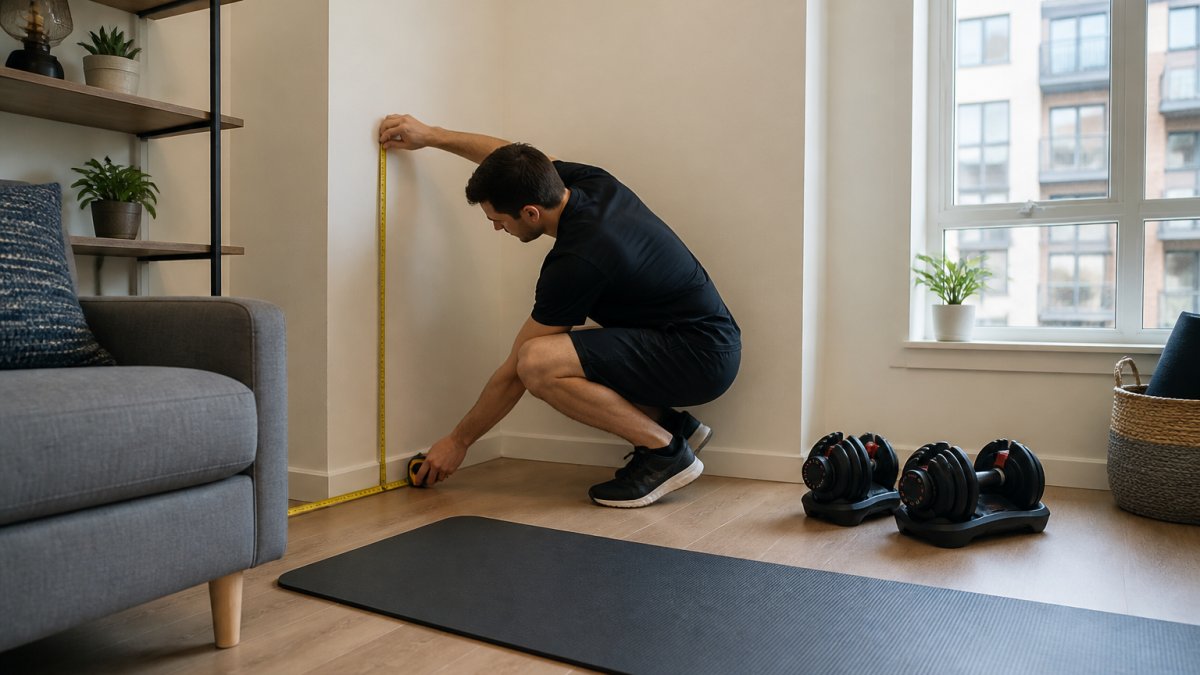
Ceiling Height and Doorway Clearance Checks
Ceiling height decides which exercises you can do standing. Standard apartment ceilings run about 8 to 9 feet, but basements and older buildings can be lower.
Check these clearances:
- Overhead press: You need your arm length plus 6 inches above your head.
- Pull-up bar: Mount it where your full reach plus a few inches fits.
- Doorway width: Most frames are 30 to 36 inches wide. A barbell is longer.
If your ceiling is low, plan around seated presses and floor-based moves. It keeps your training safe and your knuckles intact.
Space-Saving Home Gym Equipment That Actually Fits
The best space-saving home gym equipment folds, stacks, or serves more than one purpose. Buy gear that does two jobs instead of two pieces that each do one.
This is where a small-space workout layout pays off. Every item should earn its footprint. If it only does one thing and takes up a corner, it usually is not worth the space.
If a bench is part of your plan, consider the Multifunctional Foldable Weight Bench For Home Gym, which folds flat for storage. Check its dimensions against both your workout area and your storage space before buying.
For seated movement at a desk, the Gamewiu Under Desk Elliptical Exerciser With Remote is another option to consider. Measure the clearance beneath your desk and review the product details before deciding whether it fits your setup.
Adjustable Dumbbells, Resistance Bands, and Weighted Vests
Adjustable dumbbells replace a full rack of fixed weights. One pair can cover many resistance in a fraction of the space.
Resistance bands hang on a hook and cost little. They add variety without a single plate.
A weighted vest adds load to bodyweight exercises like push-ups and squats. It stores flat in a drawer.
Together, these three cover most strength training needs in a corner of a room. They also support progressive overload, the principle of gradually adding challenge to build strength.
Pull-Up Bars and Multi-Functional Racks for Renters
Renters need gear that leaves no holes behind. A doorway pull-up bar is the classic answer. It wedges into the frame and comes down in seconds.
For more range, look at multi-functional racks that fold against a wall. Some convert from a squat rack to a bench press station without extra parts.
| Equipment Type | Space Needed | Rental-Friendly? | Best For |
|---|---|---|---|
| Doorway pull-up bar | Doorway only | Yes | Upper body, calisthenics |
| Adjustable dumbbells | 2 sq ft | Yes | Full-body strength |
| Resistance bands | Hook or drawer | Yes | Warm-ups, mobility |
| Foldable rack | 4-6 sq ft | Usually | Squats, presses |
| Weighted vest | Drawer | Yes | Bodyweight load |
Budget Home Gym Setup: Where to Spend and Where to Save
A budget home gym setup works best when you spend on the items you touch every session and save on the rest. Think about what you use daily.
Spend on:
- Adjustable dumbbells, since they replace a whole rack
- A quality floor mat that protects your joints and the floor
- One sturdy pull-up bar
Save on:
- Branded accessories you can find generically
- Extra plates you may not need yet
- Fancy storage you can build from a shelf
The goal is a minimalist setup that still lets you train hard. You can always add later. Starting lean keeps your apartment livable.
Prestige Outdoor Homes carries fitness gear alongside camping and home items, so you can build a setup and stock your next trip in one order. Every order ships free.
Quiet Apartment Workout: Noise Reduction and Vibration Dampening
A quiet apartment workout protects your relationship with your neighbors. Most noise complaints trace back to two distinct problems: airborne noise (the clang of a dropped dumbbell) and structure-borne vibration (impact energy traveling through the floor slab into the unit below).
Here is the mechanism. When a weight hits the floor, kinetic energy transfers into the building structure as low-frequency vibration. Rubber mats absorb some of that energy by deforming and rebounding. The thicker and denser the mat, the more energy it dissipates before it reaches the slab.
Simple steps that help:
- Use a dense rubber mat rated for weightlifting, not a foam exercise mat
- Set weights down with control, not a drop, eccentric control cuts peak impact force
- Do high-impact moves (jump squats, burpees) on a padded surface, not bare floor
- Train during normal hours, not at midnight
- Put a felt or rubber pad under any rack or bench feet to stop metal-on-floor scrape
Floor Matting and Deadlift Platform Alternatives
Floor matting is the first line of defense. Look for dense rubber that stays flat and does not slide. Common options:
- Interlocking rubber tiles (typically 1/2 to 3/4 inch): easy to reconfigure, good for dumbbell work, moderate vibration absorption.
- Rolled rubber (3/8 to 1/2 inch): cheaper per square foot, but seams can curl and it slides on smooth floors without a rug pad underneath.
- Horse-stall mats (3/4 inch, 4x6 feet): the densest common option, heavy, and hard to move, but the best vibration dampener short of a platform.
For heavier lifting, a deadlift platform spreads the load across a wider area and adds a plywood layer that stiffens the surface so the mat does not bottom out. A full platform is typically 8x8 feet and bulky.
The trade-off is simple. Thicker mats and platforms cost more, weigh more, and take more storage. Thinner mats are cheap but let vibration through.
Noise control is not optional in an apartment. A dense mat, controlled reps, and a mini platform prevent complaints that can end your home gym altogether.
CDC physical activity guidelines for adults recommend at least 150 minutes of moderate activity each week. A quiet setup makes it easier to hit that target at home.
Vertical Storage Hacks and Rental-Friendly Modifications
Vertical storage is how you fit a gym into a small apartment without losing your living space. The goal is to move gear off the floor and onto walls, doors, and the backs of closets, without drilling, because a single anchor hole can cost you part of a security deposit.
The key distinction renters miss: damage-free methods are not interchangeable. They have very different weight limits, and exceeding them is how shelves fall and walls get gouged.
- Adhesive hooks (Command-style): rated for light items only, typically a few pounds per hook. Good for resistance bands, jump ropes, and straps. They fail on textured or freshly painted walls, and they can pull paint when removed if the wall was not cleaned first.
- Over-the-door hooks and racks: hang on the top of a door and need no adhesive. Capacity depends on the door and hinge, but most handle 10 to 20 pounds comfortably. Good for bands, straps, a foam roller, and a lightweight vest.
- Tension rods: wedge between two walls or inside a closet. Useful for hanging bands and mats, but they slip under load, so keep them to light, soft items.
- Freestanding shelving and tall cabinets: the only damage-free option that safely holds heavy gear like dumbbells and plates. A metal utility shelf rated for 200-plus pounds per shelf is the workhorse. A tall cabinet turns gear into furniture and hides it entirely.
- Wall-leaning racks: lean against the wall without anchors. They hold bars and plates, but they can tip if bumped, so place them in a corner or behind furniture.
Building a Vertical Zone in a Closet or Corner
The highest-yield move is to convert one closet or corner into a floor-to-ceiling stack:
- Floor level: heaviest items, dumbbells, plates, a folded bench.
- Mid level: a shelf for bands, straps, and a foam roller.
- Upper level: light items only, a weighted vest, gloves, a jump rope.
- Door back: over-the-door hooks for the items you grab every session.
This keeps the floor clear for your actual workout footprint and makes the zone feel intentional rather than cluttered. If you have a closet with a rod, a tension rod or a hanging shoe organizer can hold bands and small accessories without any mounting hardware.
Weigh your gear before you hang it. A pair of adjustable dumbbells can run 50 to 90 pounds total, far beyond any adhesive hook. If it is heavy, it goes on the floor or on freestanding shelving, never on a damage-free hook.
This approach keeps your deposit safe and your floor clear. It also means your workout zone can disappear into the room when you are not training.
Equipment Maintenance in Small Environments
Equipment maintenance in a small space matters more, not less. Tight quarters trap dust, sweat, and moisture against your gear.
Wipe down dumbbells and bars after each session. Sweat left on metal leads to rust, and rust spreads.
Check these monthly:
- Tighten bolts on racks and bars
- Inspect bands for cracks or thinning
- Air out mats to prevent odor and mildew
- Clean handles and grips
Store gear dry and off the floor when you can. A little upkeep keeps your investment working for years.
U.S. Consumer Product Safety Commission home fitness safety tips notes that proper equipment care reduces injury risk. A quick monthly check is worth the few minutes.
Conclusion: Your Apartment Home Gym Starts With a Plan
Building a home gym apartment is a planning problem before it is a shopping problem. Measure your space, pick versatile equipment, and control noise from day one.
Prestige Outdoor Homes makes that easier with fitness gear, storage-friendly accessories, and home items in one place. Every order ships free, so you can start your setup without extra cost.
Get started with Prestige Outdoor Homes and turn a corner of your apartment into a workout zone you will actually use.
Frequently Asked Questions
What equipment do I need for a home gym in a small apartment?
Start with adjustable dumbbells, resistance bands, and a foldable bench. These cover strength training and take up minimal footprint. Add a doorway pull-up bar if your frame allows. A weighted vest works well for bodyweight exercises and calisthenics when space is tight. For cardio, jump ropes and sliders store flat. Prioritize versatile equipment that serves multiple exercises rather than single-purpose machines.
How can I work out in an apartment without disturbing neighbors?
Use thick rubber floor matting to absorb impact and reduce vibration. Avoid dropping weights; set them down controlled. Choose low-impact exercises like resistance bands, bodyweight movements, or a quiet apartment workout routine. Schedule high-intensity interval training during daytime hours. A deadlift platform or plywood base under mats further dampens noise. Communicate with neighbors about your schedule if noise is a concern.
How do I make space for a home gym in a small apartment?
Measure your available square footage and choose a corner or wall that gets little traffic. Use vertical storage like wall-mounted racks or over-the-door hooks for bands and mats. Opt for foldable equipment that slides under a bed or couch. A small-space workout layout often works best with a 6x6 foot clear zone. Multi-functional furniture, like a bench that doubles as storage, helps maximize every inch.
Can I put a home gym in my apartment without violating my lease?
Check your lease for clauses about noise, floor coverings, and alterations. Most rentals allow freestanding equipment but prohibit permanent installations like wall-mounted racks. Use rental-friendly modifications: adhesive hooks, tension-mounted pull-up bars, and removable floor mats. Avoid bolting anything to walls or floors. If you plan to use heavy weights, consider a deadlift platform that rests on top of flooring without adhesive.