

Adjustable Dumbbells vs Kettlebells for Home Workouts
Last Updated: November 7, 2026
Quick Summary
Adjustable dumbbells suit controlled strength work and muscle growth, while kettlebells suit dynamic, full-body conditioning. Dumbbells let you load each hand separately and add weight in small steps, and one adjustable set covers many loads in a small footprint.
- Dumbbells let you load each hand separately and control the path of the weight.
- Kettlebell fixed sizes often jump 4-9 lb, which can make precise overload harder.
- Add 2.5-5 lb per hand once you hit the top of your rep range on all sets with clean form.
- Plan about 8 ft of front clearance for kettlebell swings and 6 ft × 6 ft for dumbbell work.
- Start with dumbbell-only strength work twice a week plus one short kettlebell swing session.
Table of Contents
- Adjustable Dumbbells vs Kettlebells: The Core Differences
- Kettlebell vs Dumbbell for Building Muscle
- Dumbbell vs Kettlebell for Home Workout: Full-Body, Cardio and Variety
- Adjustable Kettlebell Trade-Offs Compared With a Traditional Set
- Space, Storage and Long-Term Cost in a Small Home Gym
- Safety, Technique and Beginner Learning Curve
- Which Setup Fits Your Goals: Choosing the Right Option
- Frequently Asked Questions
Adjustable Dumbbells vs Kettlebells: The Core Differences
Choosing between adjustable dumbbells and kettlebells comes down to how you want to train. Our short answer is that adjustable dumbbells suit controlled strength work, while kettlebells suit dynamic, full-body conditioning.
Dumbbells let you load each hand separately and control the path of the weight. That makes them a strong fit for progressive strength training. A kettlebell has its center of mass away from the handle, so it shifts and swings as you move. That shifting weight rewards coordination, grip, and whole-body movement.
The biggest practical difference is versatility per dollar. An adjustable set covers many loads in one footprint. A traditional kettlebell set usually means buying several fixed weights, which takes more room.
Kettlebell vs Dumbbell for Building Muscle
If your main goal is muscle growth, adjustable dumbbells have the edge, but the reason is mechanical rather than brand loyalty. Hypertrophy responds to controlled tension, sufficient volume, and progressive overload, gradually adding resistance or reps over time. Dumbbells let you load each side independently, pause at the bottom of a press, slow the eccentric, and add small increments without changing your stance. That precision is what makes them easier to program for muscle.
Kettlebells can still build strength and size, especially through goblet squats, front-racked presses, rows, and single-arm carries. The limitation is granularity. Most fixed kettlebells jump in 4-9 lb increments (common jumps are 5-10 lb between sizes), so a lifter pressing 25 lb may have to jump to 35 lb, a 40% increase that often stalls form.
A practical hypertrophy template for either tool:
- Rep range: 6-12 for compound presses, rows, and squats; 10-20 for isolation work like curls and lateral raises.
- Sets per muscle group: 10-20 hard sets per week, split across 2-4 sessions.
- Rest: 90-180 seconds on compounds, 45-90 seconds on isolation.
- Progression: add 2.5-5 lb per hand when you hit the top of the rep range on all sets with clean form, or add one rep per set before adding load.
- Tempo: 2-3 seconds down on presses and rows to increase time under tension without adding weight.
Kettlebell-specific muscle work fits best as a supplement: goblet squats (3-4 sets of 8-12), single-arm front-rack presses (3 sets of 6-10 per side), and renegade rows (3 sets of 8-10 per side). These build real strength, but the fixed jumps make precise overload harder than with a dial-adjustable pair.
Our pick for muscle building is the 4 in 1 Adjustable Dumbbell Set, which lets you increase load in small steps. If you already own kettlebells, use them for carries and goblet work and keep the dumbbells for presses, rows, and isolation, that pairing covers the hypertrophy bases without duplicating equipment.

Dumbbell vs Kettlebell for Home Workout: Full-Body, Cardio and Variety
Kettlebells shine when you want cardio and full-body work in a short session. Swings, cleans, and snatches raise your heart rate quickly while engaging the legs, hips, and core.
Dumbbells offer more isolation options. Curls, lateral raises, and chest presses target specific muscles with less stress on the rest of the body. For balanced home training, many people use both.
Variety matters too. Adjustable sets that include a barbell mode and push-up stands let you shift between exercises without buying extra equipment.
Adjustable Kettlebell Trade-Offs Compared With a Traditional Set
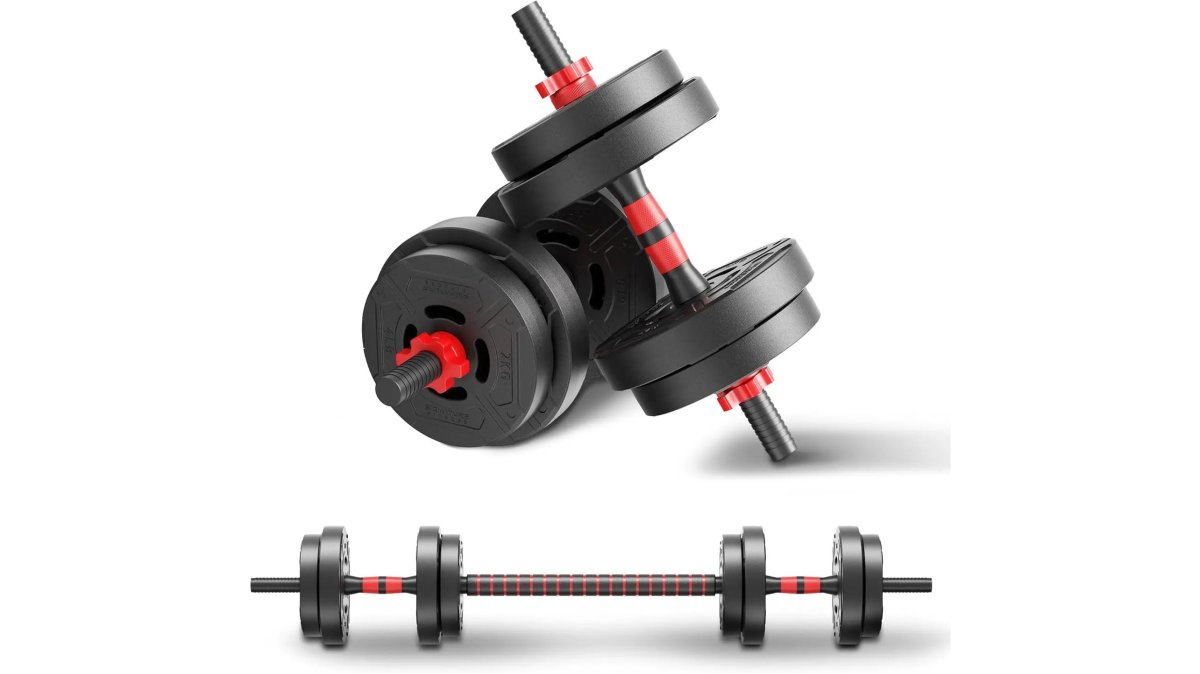
Adjustable kettlebell options bring real advantages. You can change weight without a rack of separate bells, and one unit can save floor space. The Adjustable Dumbbells, 44lbs Free Weight Set with Connector at $75.99 can be used as a kettlebell, which makes it a practical choice for a small home gym.

There are trade-offs. Adjustable kettlebells often have a narrower weight range than traditional sets. Their shape can also feel bulkier or less balanced, which may change how swings and cleans feel. Traditional kettlebells are simpler and feel more natural for ballistic moves, but they lock you into specific weights.
Space, Storage and Long-Term Cost in a Small Home Gym
Space is often the deciding factor. A compact adjustable set can slide against a wall or into a closet, while a rack of fixed kettlebells needs dedicated shelf space.
Cost works differently over time. Buying one adjustable set at $49.99 to $80.99 can replace several separate purchases. The Adjustable Convertible Dumbbell And Barbell Set at $49.99 is one option for compact spaces, since it collapses for neat storage.
Safety, Technique and Beginner Learning Curve
Beginners usually find dumbbells easier to learn because the load stays in the hands and the movement path is predictable. Kettlebell swings, cleans, and snatches are ballistic, the bell leaves the body and returns, so the skill demand is higher and the cost of a mistake is higher too. That does not make kettlebells unsafe; it makes them a tool to learn deliberately.

Dumbbell setup and progression:
- Start with a load you can control for 8-10 clean reps on a goblet squat and a floor press before adding weight.
- Keep the core braced during overhead presses and rows; avoid using momentum to swing the weight up.
- Use a bench or floor for pressing so you can bail safely if a rep stalls.
- Progress by adding 2.5-5 lb per hand once you hit the top of your rep range on all sets.
Kettlebell setup and progression:
- Learn the hip hinge with a bodyweight drill (hips back, neutral spine, shins near vertical) before loading a swing.
- Start with a bell light enough to swing to chest height with the arms relaxed, commonly 8-12 kg (about 18-26 lb) for many beginners, though this varies by size and strength.
- Master the two-hand swing for 3 sets of 10-15 reps before attempting cleans or snatches.
- Keep the bell close on cleans so it does not bang the forearm; a common pattern is to practice the clean from a dead stop before chaining reps.
Watch out: rapid kettlebell swings with a load that is too heavy can strain the lower back, and letting the bell drift away from the body on cleans is a frequent cause of forearm bruising. Build speed only after the hinge pattern is consistent.
Space and setup:
- Dumbbell work needs roughly a 6 ft × 6 ft clear area for pressing and rows, plus overhead clearance for standing presses.
- Kettlebell swings need more front-to-back room, plan for about 8 ft of clearance in front of you so the bell can travel without hitting furniture.
- Check the floor: rubber mats protect hardwood and reduce noise; kettlebells set down hard can dent soft flooring.
Beginner learning curve, side by side:
- Dumbbells: low.
- Kettlebells: moderate. The hinge and swing take a few sessions to groove; cleans and snatches take longer.
A sensible first month is dumbbell-only strength work twice a week plus one short kettlebell swing session, adding skill work only when the hinge feels automatic. That sequence builds the movement vocabulary before ballistic speed enters the picture.
The table below summarises the space and setup figures for each training style.
| Setup | Clearance needed | Note |
|---|---|---|
| Dumbbell work | 6 ft × 6 ft clear area | Plus overhead clearance for standing presses |
| Kettlebell swings | About 8 ft in front | Room for the bell to travel without hitting furniture |
| Kettlebell beginner weight | 8-12 kg (18-26 lb) | Commonly used starting range; varies by size and strength |
| Dumbbell progression | 2.5-5 lb per hand | Add once the top of the rep range is hit on all sets |
Which Setup Fits Your Goals: Choosing the Right Option
Choose adjustable dumbbells if your priority is progressive strength, muscle growth, and compact storage. Choose kettlebells if you want conditioning, dynamic full-body work, and a lighter learning curve on ballistic moves.
Best for: Home lifters who want precise loading and a small footprint. Skip if: You only plan ballistic, cardio-focused workouts and want no adjustment.
For most home gyms, we recommend starting with an adjustable set that covers both roles. The 4 in 1 Adjustable Dumbbell Set at $67.99 gives you dumbbells, a barbell, and kettlebell modes in one purchase.
Frequently Asked Questions
Are dumbbells or kettlebells better for home workouts?
Neither is universally better. Adjustable dumbbells suit controlled, progressive strength work such as presses, rows and squats, and they are easier to load in small increments. Kettlebells suit dynamic, full-body conditioning like swings and carries. Many home exercisers pick the option that matches their main goal, and some combine both when space allows.
Which is better for exercise, adjustable dumbbells or kettlebells?
It depends on the goal. Adjustable dumbbells are generally better for muscle building and precise progressive overload because weight changes are quick and fine-grained. Kettlebells are strong for conditioning, cardio and functional movements. A kettlebell's center of mass shifts the load during swings and carries, which challenges grip and stability differently than a dumbbell does.
Is there a downside to adjustable dumbbells?
Adjustable dumbbells can take longer to change weight than a fixed set, and their weight range is often limited for very heavy lifts. Some designs also feel bulkier or less balanced in certain movements. The Prestige Outdoor Homes adjustable sets, such as the 44-lb options listed at $67.99 to $80.99, may not suit advanced lifters who need heavier loads.
Which is better for me, an adjustable kettlebell or a regular kettlebell?
A regular kettlebell is simpler and more durable for swings and ballistic work, while an adjustable kettlebell saves space by covering several weights in one unit. Adjustable kettlebells usually offer narrower weight ranges and can feel less balanced than a fixed kettlebell. If you train with one or two loads, a fixed kettlebell may be the better fit.
